What is myopia?
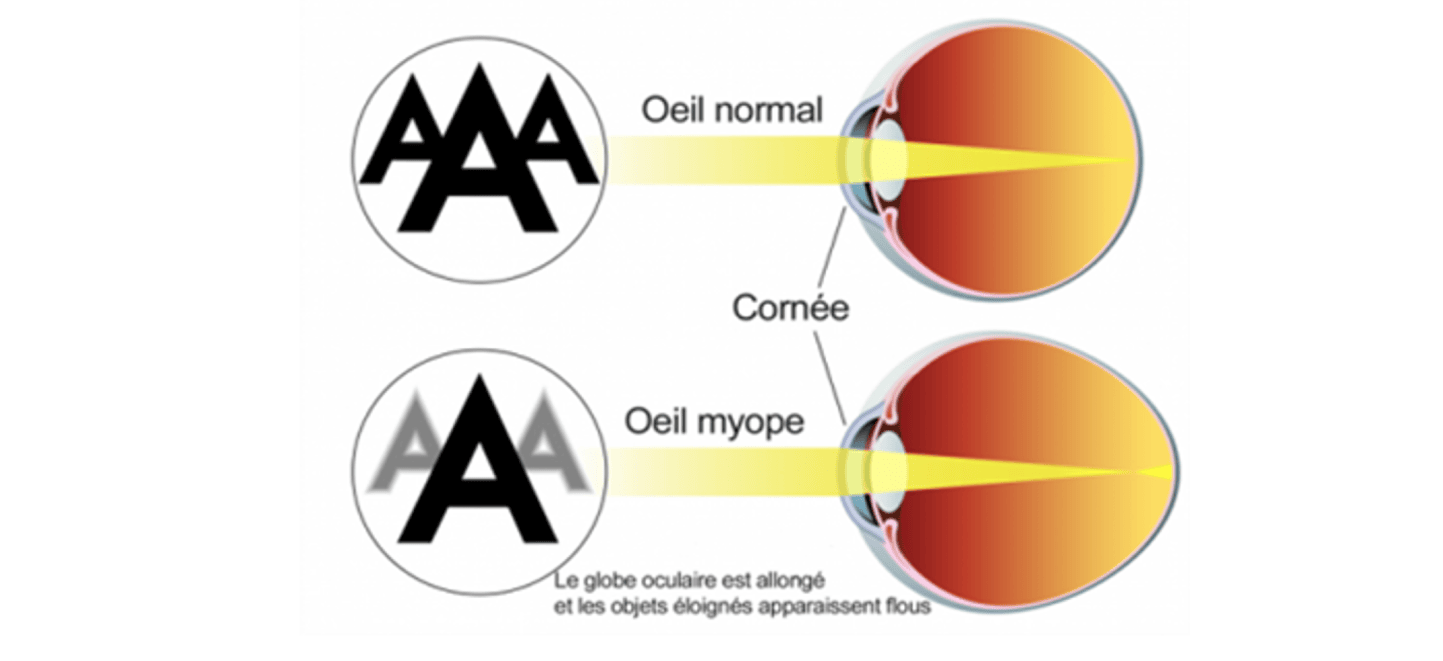
Myopia is the most common refractive disorder worldwide, affecting 25 to 40% of the Western population. It results from genetic and environmental factors. Axial myopia (the most common) involves an elongation of the eyeball which causes images to converge in front of the retina, creating blurred distance vision. Sometimes excessive corneal curvature — rather than the length of the eye — is the cause. The condition can appear at any age and progress until the sixth decade for severe cases (refractive error exceeding -6 D, axial length greater than 26 mm).

How to correct myopia?
Several approaches exist: glasses, soft contact lenses, rigid lenses, orthokeratology and refractive surgery.
Prevention of progression
- At least 40 minutes per day of exposure to natural light
- Reduction of prolonged near vision activities
- Peripheral myopic defocus lenses (Miyosmart, Stellest)
- Orthokeratology (night lenses)
- Low dose atropine eye drops
LAMAL reimbursement (from July 2024)
Basic insurance (LAMAL) now covers CHF 850 per year for optical corrections to control myopia when:
- Progressive myopia is confirmed by eyeball elongation measurements
- The correction is prescribed by an ophthalmologist (and not an optician)
- The patient is under 21 years old
Surgical correction
For adults, various surgical options can correct myopia: LASIK, PKR/TransPRK, SMILE, or phakic implants for severe myopia.